sdtransit-jan26-cuts
Atypical San Diego MTS service changes - January 2026
Alex Wenzel (atwenzel//at//protonmail//dot//com) March 28, 2026
Summary: Historically, the San Diego Metropolitan Transit System (MTS) has used “schedule adjustments” and similar language to describe small changes in trip scheduling without substantial changes in service levels. This practice appears to have changed with the January 2026 service change. MTS used “schedule adjustments” language instead to describe decreases in service during all or part of the day on 14 routes resulting in a loss of at least 113 trips relative to Fall of 2025.
Revision notes can be found here
Definitions
- headway: The amount of time between trips on a route. For example, “15 minute headways” means a vehicle arrives every 15 minutes.
- span: The amount of time in a day during which a route is operational.
Background
The San Diego Metropolitan Transit System is the public transit provider for most of central, southern, and eastern San Diego County. Like many transit agencies in the country, MTS faces budget deficits within the next few years, as the availability of federal stimulus spending during the Covid-19 pandemic obscured the need to update normal, recurring funding sources in response to inflation. After reallocating capital funding by delaying new construction and bus fleet electrification, MTS estimates it would need to save $30 million via service cuts absent a local ballot measure or other new source of funding before 2028.
With the exception of certain major changes such as the opening of the Blue Line Trolley extension in November of 2021 or the emergency service cuts due to the Covid-19 pandemic in March of 2020, MTS typically updates its bus and light rail service three times per year. These service changes serve multiple purposes. Service changes add or remove beach or school day service depending on the time of year and introduce changes in response to ridership trends or minor adjustments to scheduling based on recent performance. For example, MTS may adjust some trips on one route to start a few minutes earlier to improve a frequently-used connection with another route. Because operator scheduling is determined by seniority-based bidding system that all operators participate in at each change, routine service changes allow bus and Trolley operators to choose more preferred work based on their accrued experience.
January 2026 service change descriptions fail to list service decreases
In the weeks prior to a service change, MTS publishes a notice on its website and in print on vehicles describing the proposed changes. In the January 2026 service change, for example, MTS notes the “[d]iscontinuation of two northbound AM trips” on route 41 (UCSD - Fashion Valley via Genesee), the two earliest extra school day trips, likely due to low ridereship and more demand for those resources elsewhere in the system. However, some decreases in service are not specifically described. The service change description for route 985 (UCSD Trolley - Torrey Pines circulator) is:
Schedule adjustments in AM & PM peaks, with extended mid-day service.
On its face, this appears to be a service increase. Route 985 previously operated only during rush hour periods. However, this description does not communicate that the “[s]chedule adjustments in AM & PM peaks” are actually significant service reductions, reducing its 15 minute headways to 30 minutes (Figure 1).
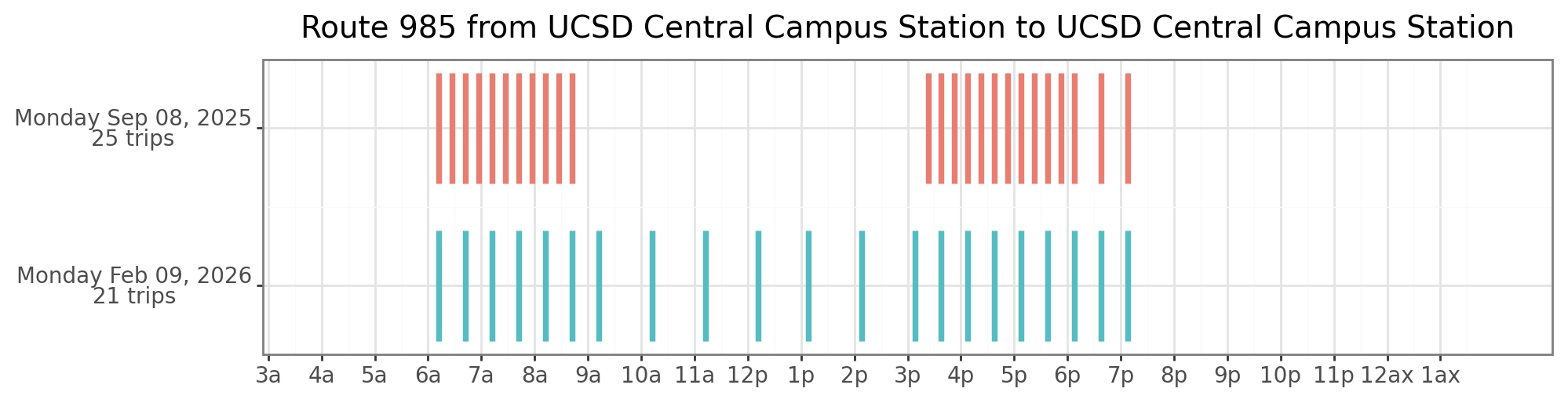 Figure 1: Changes in route 985 service between September 2025 and February 2026. The horizontal axis represents time of day, and each vertical line represents the start of a trip.
Mid-day service was indeed added, but this change reduces flexibilty for commutes as route 985 trips now connect with every other Blue Line train instead of every train and there is a net loss of 4 trips throughout the day. These changes are not clear in the service change description.
NOTE: While researching this, I discovered that MTS wrote a blog post about this service change. This post contains the following paragraph:
Adjusting to travel patterns: Another million dollar savings was found through removing some morning trips throughout the system. In general, MTS has been seeing recent travel pattern changes, with fewer people using bus service in the morning, and more frequent use in the afternoon. Using this intel, the team identified several routes and morning trippers that could be consolidated into less frequent service, while still maintaining ridership capacities.
This post, as far as I know, was not promoted publicly and was not included in any of the “Rider Insider” emails, which usually include posts like this. The vast majority of riders are unlikely to encounter this information since it was described only as “schedule adjustments” in the service change. This post was published on a Friday before the Sunday service change, leaving little time for riders to notice or adjust to this information. This post also omits some all-day headway changes, which are included below.
Route 985 is not the only route with changes like these. Below, several other routes’ service levels before and after the change are shown, along with the description accompanying the change for that route. This is not a complete list of all routes with unclear or undisclosed changes. For complete data, see this spreadsheet.
Route 35 (Ocean Beach - Old Town)
Service change description:
Weekday: AM and mid-day schedule adjustments
Actual change: Headways increase from 15 minutes to 20 minutes in both directions before 2pm.
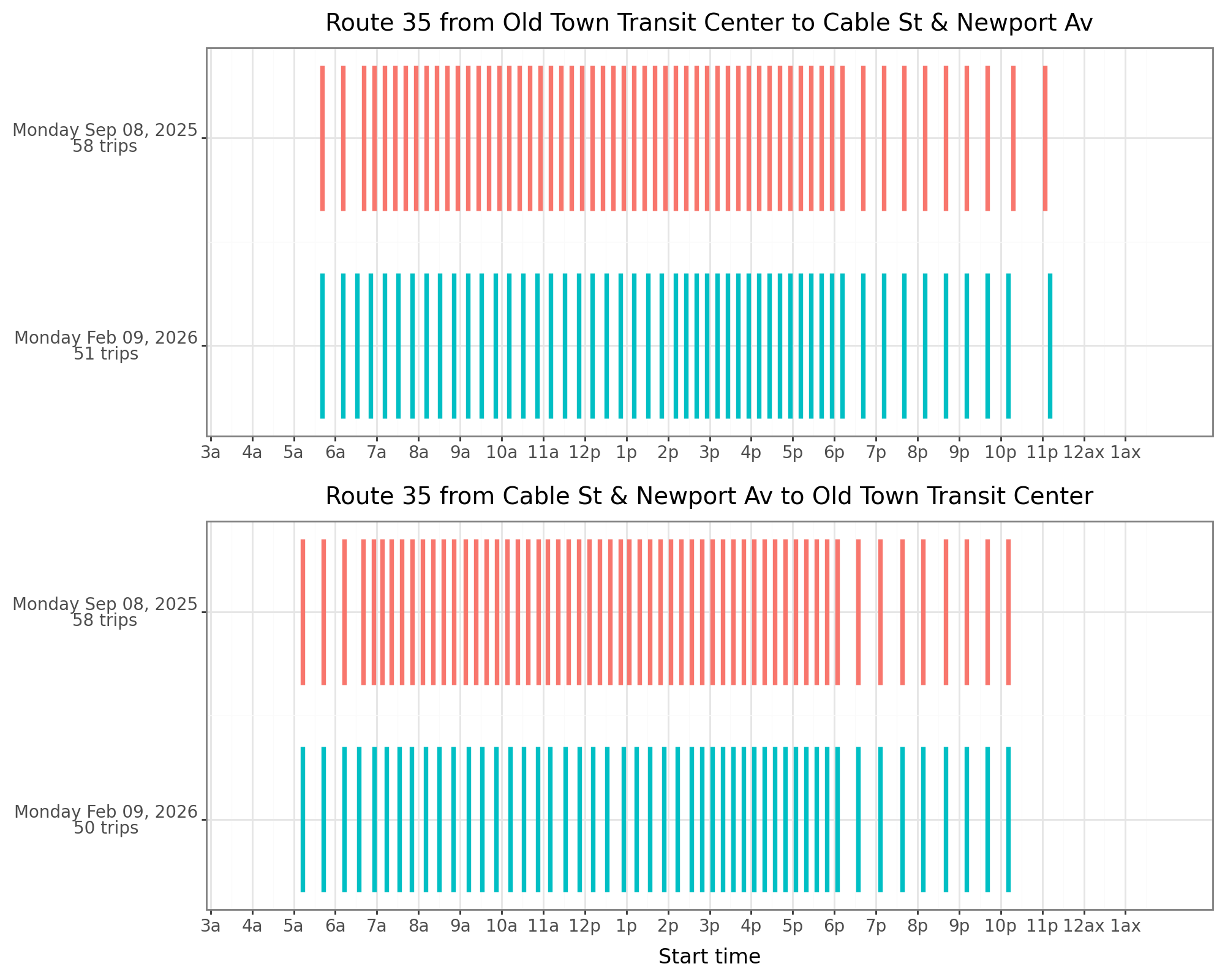 Figure 2 Changes in route 35 service between September 2025 and February 2026. There are seven fewer trips to Ocean Beach and eight fewer trips to Old Town between 5:30am and 2:00pm.
Route 962 (8th St Station - Spring Valley)
Service change description:
Weekday: AM and mid-day schedule adjustments.
Actual change: Headways increased from 15 minutes to 20 minutes between 6:30am and 2pm.
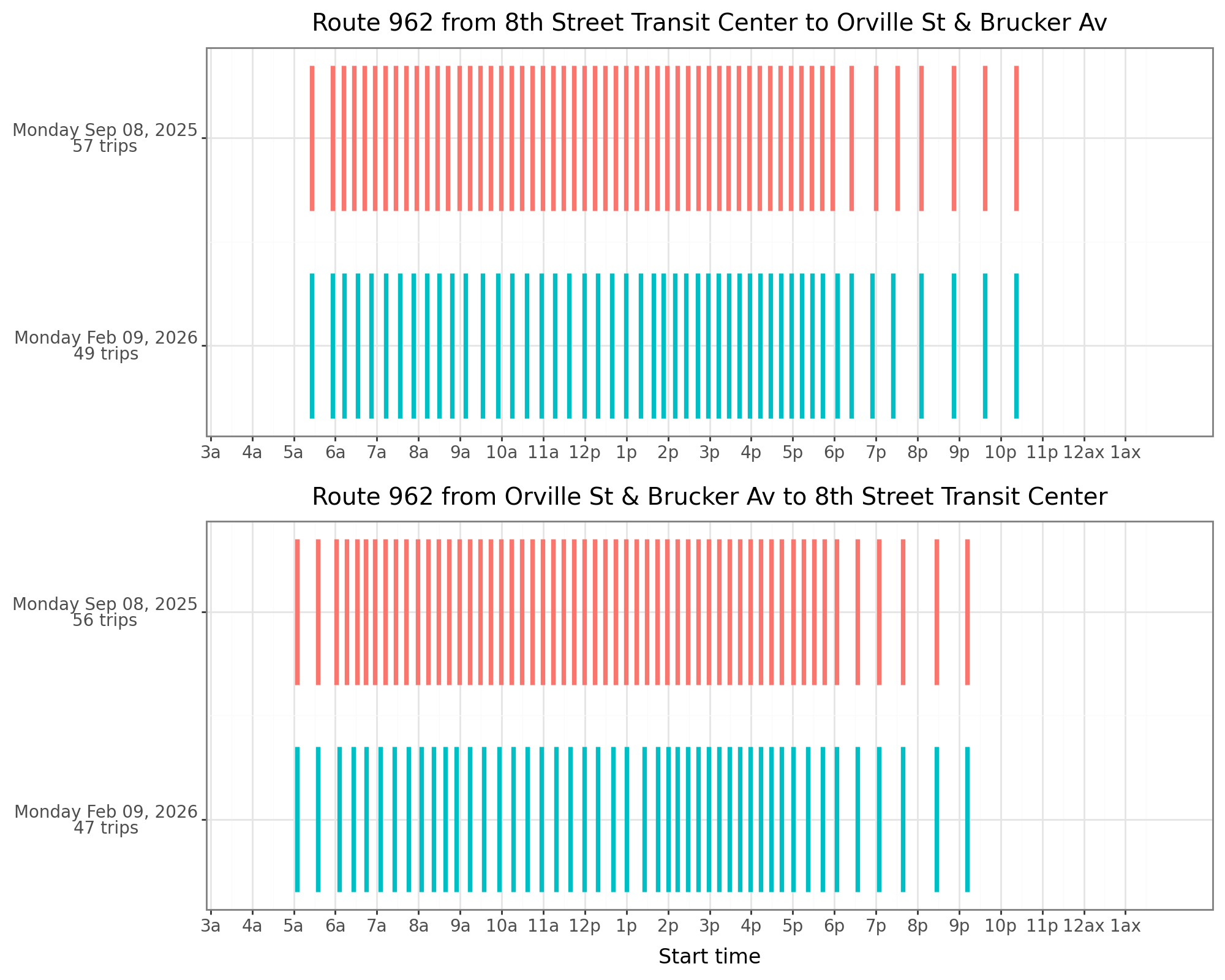 Figure 3 Changes in route 962 service between September 2025 and Feburary 2026. There are eight fewer trips to Spring Valley and nine fewer trips to 8th St Transit Center, mostly in the morning but with a couple trips removed each direction in the evening.
Route 965 (City Heights, Gateway Circulator)
Service change description:
Schedule adjustments
Actual change:Headways increased from 35 minutes to 45 minutes all day.
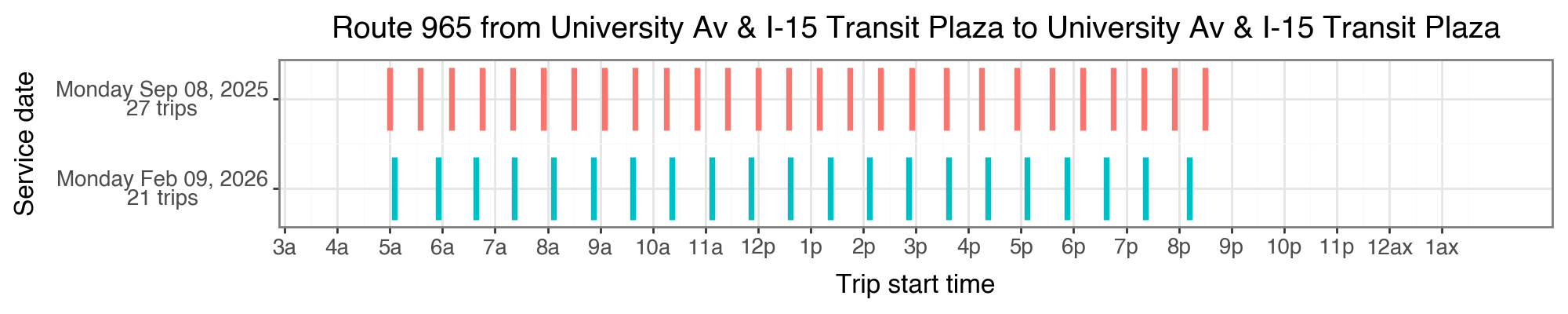 Figure 4: Changes in route 965 service between September 2025 and February 2026. The number of trips decreased each day from 27 to 21.
Route 2 (Downtown - Adams Ave via 30th St)
Service change description:
Weekday: AM schedule adjustments
Actual change: Headways increased from 15 minutes to 20 minutes to Downtown (between 9:15am and 12pm) and to Adams Ave (between 8:30am and 11:30am).
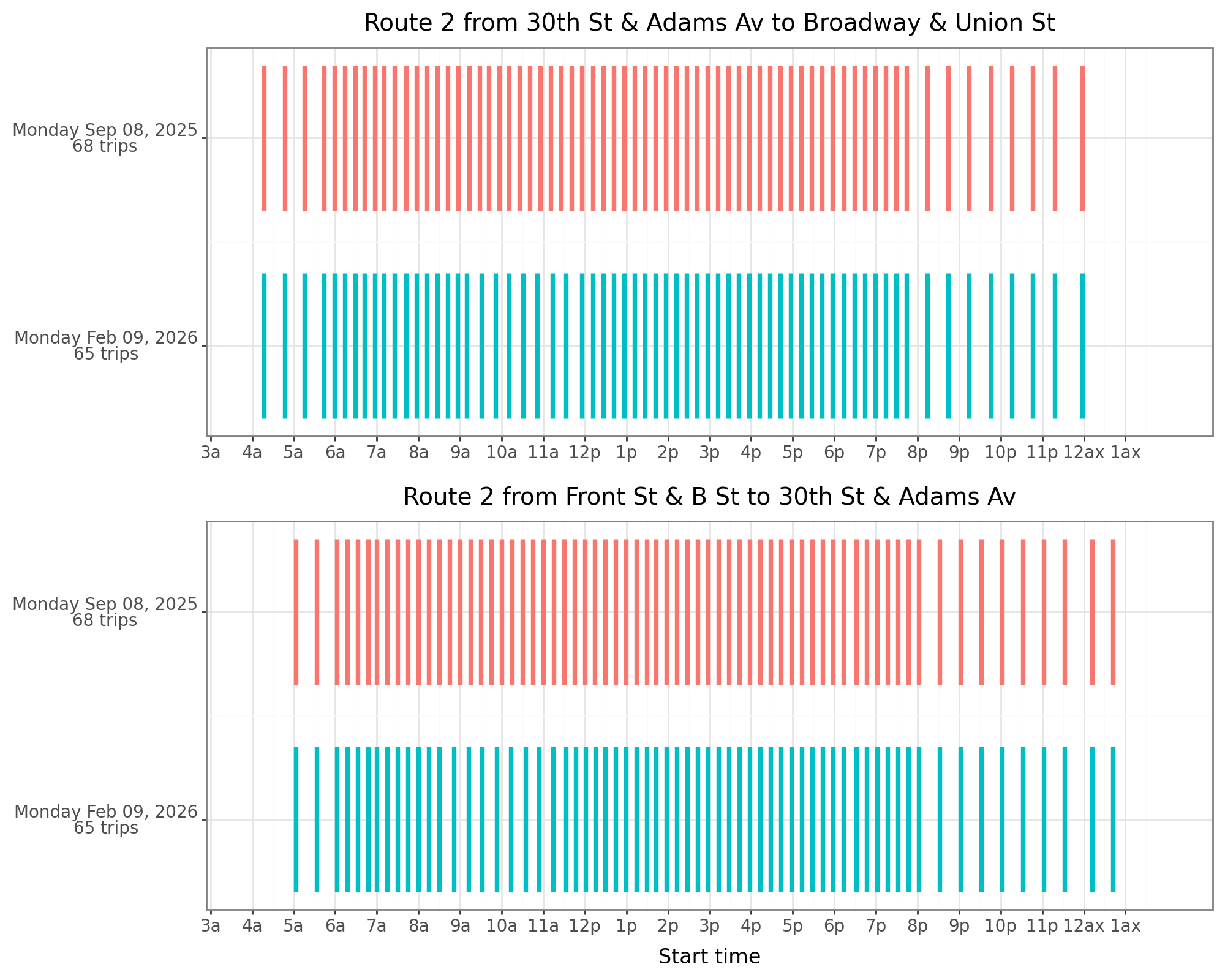 Figure 5: Changes in route 2 service between September 2025 and Feburary 2026. Headways increased from 15 minutes to 20 minutes in both directions in the late morning.
Route 872 (Southwest El Cajon Circulator)
Service change description:
Schedule adjustments.
Actual change: Service span increased by an hour in the morning and 30 minutes in the evening, but headways increased from 30 minutes to 45 minutes, decreasing the number of trips each day from 26 to 20.
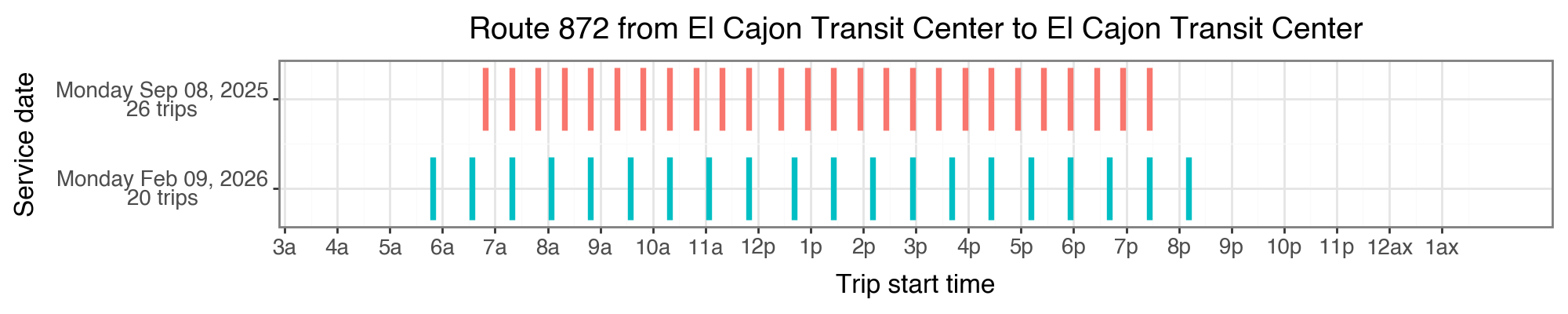 Figure 6: Changes in route 872 service between September 2025 and February 2026. Headways increased from 30 minutes to 45 minutes throughout the day.
This is not a complete list of undescribed service reductions. See complete spreadsheet for more information.
Use of “schedule adjustments” language is recently unique to January 2026 service change
Dating back to 2024, MTS has only rarely used “schedule adjustments” language to describe a decrease in service levels. The number of trips lost that aren’t explicitly documented* during each of those changes dating back to 2024 are:
- August 2024: 0 trips
- January 2025: 2 trips
- June 2025: 22 trips
- August 2025: 0 trips
In each case, a small number of trips were lost at the very end or beginning of a route each day. The majority of the June 2025 changes are five early morning route 201 trips and two early morning route 202 trips on Saturday and Sunday, accounting for 14 of the 22 trips (full data here).
Given this recent history, the dozens of trips lost in the January 2025 service change, resulting in headway changes for a number of routes, is a noticeable outlier.
Conclusion
The January 2026 service change differs substantially from prior changes in its use of the phrase “schedule adjustments” to describe significant restructuring of some routes. While these changes are arguably an operationally insigificant fraction of the several thousand trips MTS operates each day, these can be meaningful for riders whose travel times can shift by as much as 15 minutes on a single route, or who might not be able to make certain transfers they previously depended on.
This occurs at a time of uncertainty for MTS (and public transit in the United States generally). MTS will almost certainly increase fares this year, and it is preparing to ask San Diego County residents to approve a sales tax increase in 2028 to improve rather than cut service. Recent local transportation and infrastructure ballot measures at the municipal and county-wide level failed because incidents of insufficient transparency or accountability were leveraged by wealthy interests who wish to increase their own fortunes by keeping San Diego-area governments and public services unstable and residents car-dependent. In fact, while Measure G only allocated 12% of the money it would have raised to transit operations, this likely would have been enough to avoid major service cuts given the additional capital reallocations MTS has already made. There is only so much that MTS can do to distance itself from these controversies**, and these service changes may indeed be the best ones available to save money while maintaining as much core service (and ridership) as possible, but maintaining full transparency now and with any difficult choices in the future is necessary to preserve the trust on which future funding decisions will depend.
Methods
Differences in historical service changes were analyzed by comparing their accompanying GTFS file sets. Historical “take-one” notices and corresponding GTFS file sets were retrieved from the Internet Archive. The archived service change page is here, changes were taken from different snapshots of this URL. GTFS sets were retrieved from snapshots of this url. I uploaded the GTFS file sets here for easier access.
The differences for a single route between two consecutive service changes were identified by comparing service on representative dates during each service period. This workflow is implemented in a Jupyter Notebook available here, which depends on a custom GTFS parser that I developed for a different project, which is available here.
All of the data, including the representative dates used for each comparison, is available here.
*Changes described as “seasonal schedule adjustments” are not included in any part of this analysis, as these can be assumed to imply a loss or gain of school day or beach community service.
**MTS is not an entity within San Diego City or County government, it is a public agency with a Board consisting of local elected leaders and manages its own budget.